
Social Confidence: How to Feel at Ease With People
and Stop Holding Back
by Erika Slater
You’re good at your life. You run a busy week, keep track of a hundred things, and people count on you. But put you in a room full of chatter and something shifts. You go quiet. You rehearse what to say, wait for the right gap, and the moment slips past. Then you drive home replaying every word you did say, and a few you didn’t. You’re not short on ability. What’s missing is social confidence, and that can be learned.
If that sounds familiar, you’re in good company. You’re not broken; your brain learned a pattern. And a pattern you learned can change.
This page covers what social confidence really is, why it feels so hard, and practical steps you can use at your next gathering. Then we’ll look at how hypnosis can help the new way of being with people start to feel natural.

On this page
What is social confidence, really?
Social confidence is feeling at ease being yourself around other people. It isn’t being loud, outgoing or the life of the party. It’s being able to listen, speak up when you want to, and head home without replaying the whole evening. Quiet people can be very socially confident. They just do it quietly.
A lot of us grew up thinking confidence looks like the person telling the best story at dinner. That’s one kind. Another kind is the person who says little, says it calmly, and doesn’t spend the next morning picking it apart.
Being an introvert or an extrovert is about where you get your energy. Social confidence is about how safe you feel being you. You can love a quiet night in and still walk into a room feeling steady.
Groups need different kinds of people, too. A group where everyone talks and nobody listens doesn’t last long. Your calm, thoughtful way is part of what makes a group work. You don’t need to become someone else. You just need to stop hiding who you are.
Why does social confidence feel so hard?
Social confidence feels hard because your brain has learned that holding back keeps you safe. Somewhere along the way, speaking up felt risky. Maybe you were embarrassed, brushed aside or criticized. Your brain took note. Now it steers you toward silence before you’ve had a chance to think.
It’s a habit loop, and it runs like this:
- Trigger: a pause in the conversation, or someone turns to you.
- Thought or feeling: “What if I say something stupid?” Your chest tightens.
- Behavior: you stay quiet, or say something small and safe.
- Payoff: nothing goes wrong, and the tension drops.
That payoff is the hidden benefit. Holding back gives you safety. Nobody can judge what you didn’t say. So your brain marks it as a win and does it again next time.
The cost comes later. You leave feeling invisible. You think of the perfect comment in the car. And when you never say what you need, resentment can creep in, toward other people and toward yourself.
Here’s the good news. The thing that built this habit was repetition, and repetition can build a new one. Practice a different response often enough and it starts to become the one your brain reaches for first.
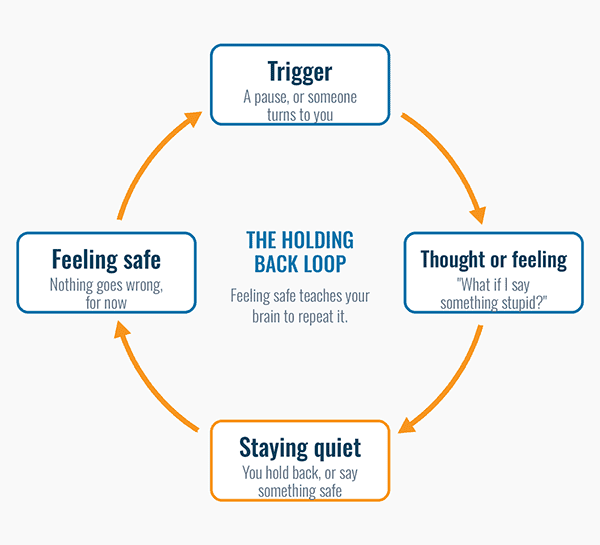
Habit loop of holding back
What does low social confidence look like?
Low social confidence shows up in different ways for different people. Here are five of the most common. For some people, it shows up as a smile at the wrong moment. If that’s you, here’s how to stop smiling when you’re nervous.
Comparing yourself to others
Comparing yourself to others is normal. It becomes a problem when you always come out behind. You’re measuring your inside, with all its doubts, against someone else’s outside, which looks polished. That’s not a fair contest, and you’ll lose it every time.
Use comparison for ideas, not as a scorecard. If someone handles a group with ease, ask what they do that you could try. Then get back to running your own race, at your own pace.
Feeling like a fraud
Feeling like a fraud means you’ve earned your place but don’t believe it. You wait to be found out. When something goes well, you call it luck. Some people call this impostor syndrome. It’s common in capable people, and it often gets loudest just before you try something new.
That inner critic thinks it’s protecting you from a fall. Thank it, then carry on: “Thanks for sharing. I’ve got this.” Then try this. Each evening, write down one thing you did well that day. Small things count. In a month, you’ll have a list that’s hard to argue with.
Going quiet in groups
Going quiet in groups happens when the talk feels too fast and the stakes feel too high. You wait for the perfect moment and the perfect words. By the time you find them, everyone’s moved on. One on one, you’re fine. Add four more people and you fade into the wallpaper.
Perfect isn’t the goal. A simple “I agree, and…” or one good question is enough to get you in.
Fear of conflict
Fear of conflict means you bite your tongue to keep the peace. You don’t say what you think in case it starts an argument. Then you stew about it for hours, or days. It feels kind at the time, but over time it can leave you feeling taken for granted.
Speaking your mind doesn’t have to mean a fight. You can be honest and kind in the same sentence: “I see it a bit differently. Here’s why.” If that feels hard, practice it out loud with someone you trust first. Saying it early and calmly beats holding it in until it comes out sideways.
Feeling left out or socially excluded
Feeling socially excluded hurts, and it’s easy to read it as proof that something’s wrong with you. Usually it isn’t. People form groups for all kinds of reasons: shared history, timing, plain habit. Being left out often says more about their choices than about your worth.
When it happens, notice the story you tell yourself. “They don’t like me” is one story. “I wasn’t in the loop” is another, and it’s often closer to the truth.
Watch out for reshaping yourself to fit in. Agreeing with things you don’t believe, or laughing at jokes you don’t find funny, might earn you a seat. But it costs you. Over time, you end up leaving yourself out. Look for the people you can relax around, even if there are only one or two.
How do I build confidence in group settings?
Confidence in group settings comes from small, steady steps, not a personality makeover. Arrive early, while the group is still small. Start with one person. Set one tiny goal, like asking one question. And put your attention on other people instead of on yourself. That’s where the pressure starts to ease.
Prefer to watch? Erika walks you through four simple techniques in this short video
- Arrive early. Walking into a room of three is easier than walking into a room of thirty. The room fills up around you while you settle in. You also get first pick of the snacks.
- Start with one person. Look for someone standing on their own. They’ll likely be glad you came over.
- Set one small goal. One question. One comment. One new name. Once you’ve done it, anything else is a bonus.
- Focus on what you can control. You can’t control what people think of you. You can control what you say to yourself. Swap “Don’t mess this up” for “I’m here to meet a few people.”
- Watch for the other extreme. If nerves make you talk too much, pause and let others take a turn. Their faces will tell you when they’d like to jump in.
How do I join a conversation without forcing it?
The easiest way to join a conversation is to ask a question. Questions take the spotlight off you and put it on the other person. They can’t really be wrong. And most people enjoy being asked about themselves. Start small and listen to the answer. Your next question usually comes from that.
A few easy ways in:
- Pick up a thread: “You went to Maine? Where did you stay?”
- Ask for an opinion: “What did you think of it?”
- Agree and add: “I had the same problem. Did you ever sort it out?”
Then listen. Really listen. People notice when someone pays attention, and it’s rarer than it should be. The person who asked the good questions is often the one people remember warmly. As you get more comfortable, you’ll start adding your own stories. There’s no rush.
How do I speak up when I haven’t prepared?
When you’re asked to speak without warning, pause, breathe out slowly, and say one clear thing. You don’t need a speech. One sentence is enough. It can feel like everyone’s watching. In truth, most people are thinking about their own day, or what they’ll say next.
- A two-second pause looks thoughtful, not lost.
- Breathe out slowly. A long, slow out-breath helps your body settle.
- Say one thing. Your honest view, a question, or “Let me think about that and come back to you.” That last one’s a perfectly good answer.
Remember, you already do this all the time. Every time you chat with friends, you’re speaking without a script. The words come out fine there. What changes in a meeting is the story you’re telling yourself about the room.
What is my body saying before I speak?
Your body speaks before you do. Slumped shoulders, crossed arms and eyes on the floor can say “leave me alone” even when you’d love someone to come over. Small changes help: shoulders down and back, arms loose, hands open, and easy eye contact. You don’t need to fake anything. Just stop sending signals you don’t mean.
- Shoulders: let them drop away from your ears, then roll them gently back.
- Arms: keep them uncrossed. Crossed arms can read as closed off, even when you’re only cold.
- Hands: open and still. Hold a drink if it helps. It gives your hands a job.
- Eyes: look at the person speaking. Soft, steady eye contact, not a stare.
- Feet: point them toward the people you’re talking with.
Aim for natural, not staged. Your body shows what you feel, so the real goal is to feel a little calmer and let your body follow. One slow breath out before you walk in helps with both.

How do I be myself instead of performing?
Being yourself starts with dropping the script. When you’re performing, you’re busy managing how you come across. That’s tiring, and it keeps people at arm’s length. Let yourself be the quieter, thoughtful version of you. The people worth knowing will like that version just fine.
Performing often comes from wanting to please. You say what you think people want to hear so you don’t let anyone down. But each time, you let yourself down a little. You’re also hiding the real you from people who might enjoy her.
Here’s a practice that helps. For two to five minutes a day, close your eyes and picture an event coming up. See yourself there: relaxed, listening, saying what you think. Notice how that feels. Your mind gets a rehearsal, so the real thing feels less new. Think of it as sending your confidence ahead of you.
You won’t get it right every time. Nobody does. Being yourself includes the awkward bits.
When is it more than shyness?
Shyness is common, and many people work on it with steps like the ones on this page. But if your fear of social situations is severe, has lasted a long time, or is stopping you from working, studying or seeing people you care about, please talk to a licensed mental health professional first. That’s the right first step. Hypnosis can sit alongside that care, but it isn’t a replacement for it.
How does hypnosis for shyness work?
Hypnosis for shyness helps you practice a calmer response at the exact moment you’d normally hold back. Hypnosis helps you work with the part of your mind that runs habits automatically, so change stops feeling like a fight. You rehearse the new response until it starts to feel like your own.
If you’ve tried to overcome shyness with willpower alone, you know how tiring it is. Holding back fires faster than you can think. That’s why working with the habit, not against it, makes such a difference.
Hypnosis isn’t magic, and nobody takes over your mind. It’s a natural, focused state, like being absorbed in a good book. You stay aware and in control the whole time. You can read more about what hypnosis is and isn’t. Here’s how I use it in my confidence and self-esteem hypnosis work.
Step 1: Clarify the target
First, we get specific. Which situations are hardest: work meetings, parties, family gatherings? What happens in your body when they start? And what would you like to feel instead: calm, curious, steady? A clear target gives us something real to work toward.
Step 2: Find the pattern
Next, we map your loop. What’s the trigger? What thought follows? What do you do? And what’s the payoff? For most people, the payoff for staying quiet is simple: nothing can go wrong. Once you see what holding back has been doing for you, you can give that job to something better.
Step 3: Install the upgrade
In hypnosis, we rehearse a new response right at the trigger point: a slow breath, a settled body, one simple sentence. We add identity language, like “I’m the kind of person who says what I think, calmly.” Then you picture yourself using it in real situations, so it feels familiar before you need it.
Step 4: Reinforce in real life
You leave with a small daily practice of two to five minutes. We also plan for the evenings that don’t go well, because some won’t. No shame. You notice what happened, take one lesson from it, and let the rest go. Then you carry on. Every try is one more repeat for the new habit.
What happens in a hypnosis session?
In a session, we start by talking about what you’d like to change. Then I guide you into a relaxed, focused state where you rehearse your new response. You’re awake and aware throughout, and you can speak or stop at any time. Most people say it feels like a pleasant daydream.
We go at your pace, toward your goals. You can see me in my office in Mashpee, on Cape Cod, or online from home. You’ll leave with a short practice to use before your next gathering.
Frequently asked questions
Is shyness the same as social anxiety?
No. Shyness is a common feeling of holding back around people. Social anxiety disorder is a medical condition, and it’s best looked at by a licensed mental health professional. If you’re not sure which fits you, talk to your doctor first.
Can an introvert be socially confident?
Yes. Being an introvert is about where you get your energy. Social confidence is about feeling at ease being yourself. Plenty of quiet people are both.
Will hypnosis make me say or do things I don’t want to?
No. You stay aware and in control the whole time. Hypnosis helps you practice responses you choose. It can’t make you act against your wishes.
How many sessions will I need?
Everyone is different. We’ll look at your goals and talk it through in your free consultation, so you know what to expect before you decide anything.
Can I work on this at home?
Yes. The steps on this page are a good place to start. If you’d like more structure, the Mind Shift Method is a self-directed program you can work through at home, at your own pace.
What’s your next step?
If this sounds like you, you don’t have to keep holding back. You can work on the pattern at home, at your own pace, or work with me directly. Either way, the aim is the same: feeling at ease being yourself around people. Start wherever feels right.
Want to work on it at your own pace?
Holding back in company is a habit your brain learned. The Mind Shift Method is my self-directed habit change program, built to help you find your pattern and practice a new response. It includes videos, worksheets and a hypnosis audio. You work through it at home, in private, on your own schedule.
Rather work with me directly?
You don’t have to do this alone. In a free 20-minute consultation, we’ll talk about when your nervous smile shows up and what you’d like instead. Then let’s make a plan that fits your real life. No pressure, no obligation.
Erika Slater, CH, has been a certified hypnotist since 2004. She runs Free At Last Hypnosis in Mashpee on Cape Cod, where she helps adults build confidence and change stubborn habits, working with clients in person and online.
CATEGORIES
FEATURED POSTS
Interested in making a significant change in your life and interested in learning more about what I do and how I do it? Discover my hypnotherapy services here or contact me here.

DISCOVER HOW TO START CHANGING HABITS TODAY.
In this free audio hypnosis session, you’ll experience the power of your subconscious mind to begin to change your habits. If you've never experienced hypnosis before then this is a great introduction...
