
How to Overcome the Fear of Fainting (Asthenophobia)
by Erika Slater
You’re in a warm, crowded room. Or a long line. Or the chair at the lab, sleeve rolled up. Then the thought lands, right on schedule: “What if I pass out right here, in front of everyone?”
If that thought follows you around, you may have asthenophobia. That’s the name for a strong fear of fainting or feeling weak. It can make you skip the meeting, the concert, the blood test, and the family party. Year by year, it can shrink your life.
Here’s the good news. You’re not broken. Your brain learned a pattern, and patterns can be unlearned. Let me show you how.

In this article:
How Do You Overcome the Fear of Fainting?
You overcome the fear of fainting by changing how you respond to the body feelings that set it off, not by trying to never feel them. That means getting a medical all-clear, learning what the fear is doing, breaking the habit of body scanning, rehearsing a steadier response to the places you avoid, and practicing that calm every day. Here’s each step.
Get the medical all-clear first
If you’ve actually fainted, or you often feel faint or dizzy, see your doctor before you do anything else. Fainting can have physical causes, and your doctor can rule them out. I say more about this below. Once you have the all-clear, the steps that follow are for the fear itself.
Learn what the fear is doing
Fear is your brain’s alarm system. When it decides a crowded room is risky, it turns up your alertness. Your heart speeds up. You feel warm. Your legs may feel odd. These feelings are the alarm going off. They’re not proof you’re about to drop.
Knowing this doesn’t switch the alarm off. But “the alarm is going again” is a very different thought from “I’m going down.”
Stop scanning your body for signs
Many people with this fear check their body all day. Is my head light? Are my hands tingling? Here’s the trouble. If you go looking for odd feelings, you’ll find them. Everyone has them. The finding feeds the fear, and the fear makes more feelings.
When you catch yourself scanning, move your attention outward. Name five things you can see, four you can hear, three you can touch. It sounds too simple to work. Do it anyway. You’re teaching your brain where to point.
Rehearse a steadier response to the places you avoid
Avoiding places keeps the fear alive, because your brain never gets to learn a different ending. You can start giving it one at home. Sit somewhere quiet and picture a movie screen a little way in front of you. On it, watch yourself in a place you’ve been avoiding: the warm meeting room, the long line, the chair at the lab. See that version of you notice the first flutter, take a slow breath, and stay, looking steady and maybe a little bored. Notice how they stand and how they breathe. A minute or two, most days.
You’re not forcing yourself to feel anything. You’re giving your brain a different possibility to rehearse, and repetition makes it familiar. Start with a place that’s only mildly uncomfortable. If picturing it upsets you, stop. There’s no benefit in pushing through overwhelming fear.
Practice calm on purpose, every day
A calm body is easier to steer. Spend two to five minutes a day on slow breathing or self-hypnosis, when you’re not anxious. You’re learning the song before the concert, not during it.
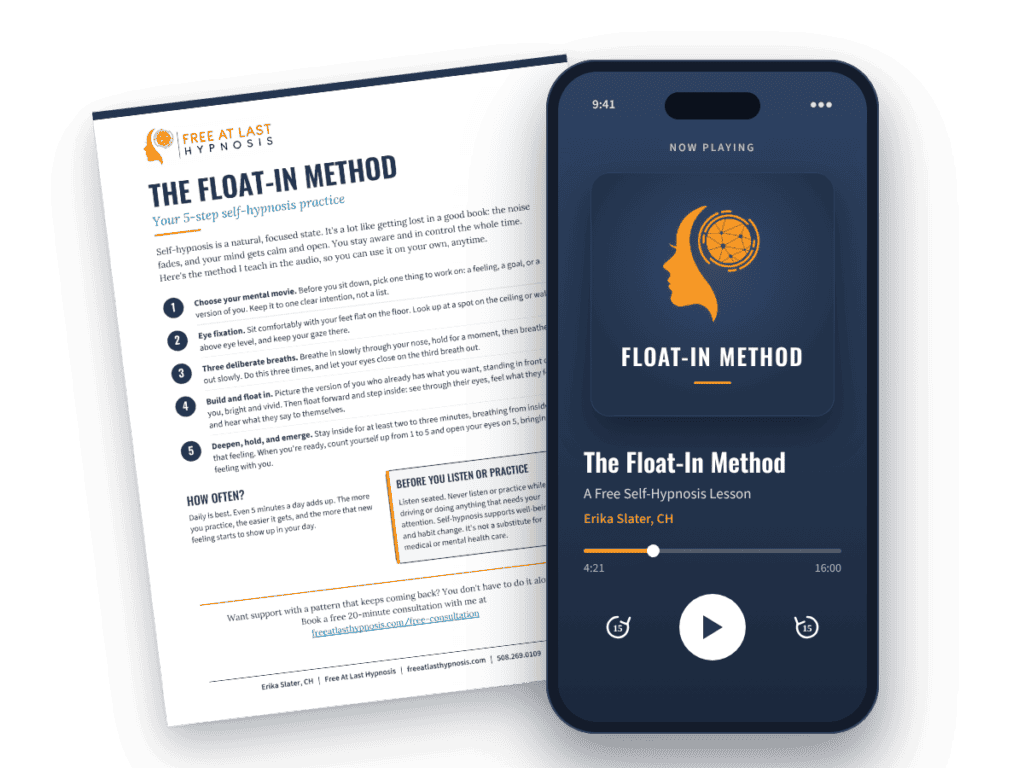
If you’d like a guided way to do this, try a free 16-minute self-hypnosis lesson. It’s called the Float-In Method, and it teaches you to calm your body and mind, then rehearse the outcome you want: the meeting, the line, or the blood test, with you steady in it. Listen seated, never while driving.
Change the story you tell about yourself
“I’m the kind of person who faints” is a story. So is “I’m someone who can feel a wobble and keep going.” Your brain can get used to either. Pick the second one and say it, especially on the days you don’t believe it yet. Identity shifts are slow and quiet, and they stick.
If you’d like help working through these steps, my Phobias and Fears program walks through them with you.
What Is Asthenophobia?
Asthenophobia is a strong, lasting fear of fainting, feeling weak, or collapsing. The word comes from the Greek for weakness. The fear is out of step with any real risk, and it leads people to avoid places where fainting would be likely, or embarrassing, or both.
People describe it to me in one of three ways. Some fear fainting itself: they’re sure something will give out in public, though they feel fine at home. Some fear weakness: tired legs or a tingle in one hand means the whole body is about to fail. And some fear dizziness: a floaty, far-away feeling convinces them they’ll fall asleep standing up. (Spoiler: they almost never do.)
Many people have a mix of all three. Whatever shape it takes, it runs on the same engine, and so does nearly every other fear. If your fear has a different name, I’ve written about fears and phobias more widely here.
Why Does the Fear of Fainting Start?
The fear of fainting usually starts with one bad moment. You fainted, or nearly did, or felt so dizzy you were sure you would. Your brain filed that moment under “danger.” Now it sounds the alarm whenever something looks like that day: the heat, the crowd, the standing still.
Here’s the pattern, step by step.
- Trigger: a warm room, a long line, a needle, a meeting with no easy exit.
- Feeling: a warm flush, a racing heart, and the thought “oh no, not here.”
- Behavior: you leave, sit down, grip the chair, or decide not to go next time.
- Payoff: relief, right away.
That last step is the sneaky one. Relief feels like proof you did the right thing, so your brain learns that avoiding works. Each time, the fear gets a little bigger and your world gets a little smaller.
None of this means you’re weak. It means your brain is good at learning. We’re going to teach it something new.
Fear of Fainting in Public
The fear of fainting in public is usually more about embarrassment than injury. Most people aren’t afraid of the floor. They’re afraid of the faces: the fuss, the stares, being helped out of the meeting. That’s why the fear often disappears at home, where nobody’s watching.
If this is you, you probably have a few habits that feel like safety. You stand near the exit. You carry water everywhere. You scan a room for a chair before you’ve scanned it for friends.
These habits feel helpful, but they tell your brain: “This place is dangerous, and I only got through it because of my water bottle.” So the fear stays. Letting go of these props one at a time is part of the work, and it gets easier once the steadier response feels familiar.
When Should You See a Doctor?
Fainting itself can have medical causes. If you’ve actually fainted, or you often feel faint, dizzy or lightheaded, your first step is a visit to your doctor, who can check for those causes and treat them if needed. Hypnosis works on the fear, not on fainting itself. If your fear comes with frequent panic attacks, or it’s stopping you from living your life, a licensed mental health professional is a good next step, and hypnosis can sit alongside that care.
How Does Hypnosis Help With the Fear of Fainting?
Hypnosis helps you work with the part of your mind that runs habits automatically, so change stops feeling like a fight. The fear of fainting is a fast, automatic response. Hypnosis lets us reach the part of your mind that fires it and teach it a calmer response at the trigger point.
If hypnosis is new to you, it’s a natural, focused state of attention, a bit like being lost in a good book. You stay aware and in control the whole time. In my Phobias and Fears program, we follow four steps.
Clarify the target
We get specific. Which situations set off the fear? What would you like to feel instead: steady, curious, maybe even a little bored? Clear targets make for clear sessions.
Find the pattern
We map your trigger, feeling, behavior and payoff, with your details in it. Most people are surprised how predictable their fear is once it’s written down. Predictable is good. Predictable can be changed.
Install the upgrade
This has two parts. If one bad moment taught your brain this fear, we first work with that memory from a distance, in a calm, focused state, so it loses its charge. Then we rehearse a new response at the trigger point. You picture the warm room, notice the first flutter, and answer it with a slow breath and steady feet. We use identity language too: “I’m someone who can feel a wobble and keep going.” And we rehearse the exact places you’ve been avoiding, in your mind first, so they’re familiar when you get there.
Reinforce in real life
You leave with a short daily practice, two to five minutes, and a plan for the days it doesn’t go well. Slips happen. A slip isn’t a failure; it’s information. We course-correct, with no shame attached, and keep going.
What Happens in a Session?
A session starts with a conversation, not a swinging watch. We talk about where the fear shows up and what you’d like instead. Then I guide you into a calm, focused state. You stay aware and can speak at any time. We rehearse the situations you’ve been avoiding, and you leave with something to practice.
Sessions happen in my office in Mashpee on Cape Cod or online, and both work well for this fear. You set the pace, and nothing happens that you haven’t agreed to. Most people tell me it’s the most relaxed they’ve felt in a long while.

Frequently Asked Questions
Is asthenophobia the same as a fear of fainting?
Yes. Asthenophobia is the formal name for a strong fear of fainting, weakness or collapse. Most people just call it a fear of fainting or a fear of passing out. Whichever name you use, the pattern underneath is the same, and so is the way through it.
Can the fear of fainting actually make you faint?
For most people, no. Fear tends to make you feel shaky, warm and lightheaded, which feels like fainting but isn’t. Fainting itself has physical causes your doctor can check, so if you have fainted, start there. The fear and the faint are two different things, and hypnosis works on the fear.
How long does it take to get over a fear of fainting?
It depends on how long you’ve had it and how much of your life it touches. Some people notice a shift after a few sessions and a few weeks of practice. Others take longer. Steady practice between sessions matters most, and I’ll give you simple tools for that.
Does hypnosis help with the fear of fainting in public?
Hypnosis is well suited to this fear because the public version runs on automatic: a trigger, a flush of feeling, and the urge to escape. In hypnosis we rehearse a calmer response to that exact moment, and repeat it until the real room feels like somewhere you’ve already been.
Can I do hypnosis for this online?
Yes. I work with clients online as well as in my Mashpee office, and this fear responds well either way. You’ll need a quiet room, a comfortable chair and a steady internet connection. Many people find starting at home easier. That’s fine. We build out from there.
Where to Go From Here
If this sounds like you, you don’t have to do this alone. The fear of fainting is a pattern your brain learned, and patterns can change. Let’s make a plan that fits your real life. Pick the step that fits where you are today.
Start with a free self-hypnosis lesson.
My free 16-minute audio, The Float-In Method, teaches you a simple way to calm your body and mind, then rehearse the outcome you want. Practice it with the meeting, the long line or the blood test in mind, so the calm is there when you need it. Listen seated, never while driving. Get the free audio
Go deeper with the Mind Shift Method.
This is the full program the free lesson comes from. It uses short videos, simple guides and hypnosis audio to help you change a pattern that keeps repeating, at your own pace. Learn about the Mind Shift Method
Talk with me.
If you’d like one-on-one help, book a free 20-minute consultation. We’ll talk about where the fear shows up and whether working together is a good fit. No pressure, just a conversation. Book your free consultation
Erika Slater, CH, is a certified hypnotist who has helped people change unwanted patterns since 2004. She works with clients in person in Mashpee on Cape Cod and online.
CATEGORIES
FEATURED POSTS
Interested in making a significant change in your life and interested in learning more about what I do and how I do it? Discover my hypnotherapy services here or contact me here.
Learn Self-Hypnosis in 16 Minutes, Free
In this free audio lesson, I'll teach you the float-in method. It's a simple way to work with your mind instead of fighting it. You'll do it once with me guiding you. Then you can use it on your own, anytime. A one-page guide comes with it.
