
Breaking the Pattern: How to Stop Repeating the Habits
You Want to Change
by Erika Slater
It’s 9 p.m. and you’re in the kitchen again. Or you’ve put off the same phone call for a week. Or you hear yourself snap at someone you love, and you think, “Why do I keep doing this? How do I break this pattern?”
You’re smart. You have high standards. You’ve tried willpower, more than once. And still the same loop comes back.
Here’s the good news. You’re not broken, and this isn’t a character flaw. Your brain learned a pattern, and patterns can change. This page shows you how to break a pattern you keep repeating, step by step, and where hypnosis can help.

In this article:
- How Do You Break a Pattern You Keep Repeating?
- How Do Habits Really Work?
- How to Overcome Stubbornness (and What It’s Protecting)
- How Do You Break Through a Mental Block?
- How Does the Way You See Yourself Shape What You Do?
- When Your Thoughts and Words Run the Show
- Where Do These Patterns Show Up?
- What If the Pattern Is Guilt About the Past?
- When Should You Get More Help?
- How Does Hypnosis Help You Break a Pattern?
- What Happens in a Session?
- Frequently Asked Questions About Breaking a Pattern
- Where to Go From Here
How Do You Break a Pattern You Keep Repeating?
To break a pattern, first get clear on what you want instead. Then catch the loop while it’s running, so you see what sets it off. Pick a new response for that exact moment. Then practice it a little every day, and have a plan for the days it slips. Here’s how each step works.
1. Get clear on what you want instead
“Stop snacking” is a start, but it isn’t a target. Get specific. What do you want to stop or start? When does the habit show up? And how do you want to feel instead?
For example: “When I get home from work, I want to feel settled, not grab the chips.” Now your brain has somewhere to go. It’s hard to walk toward “not chips.”
2. Catch the loop while it’s running
Every habit has a moment when it starts. Your job is to notice that moment. The first few times, you might catch it halfway through the bag. That’s fine. Noticing is the skill, and each time you notice, you’ll catch it a little sooner.
A simple tool here is a small action that breaks the autopilot, like standing up, taking a slow breath or saying “There it is” out loud. My post on how a pattern interrupt works goes deeper.
3. Choose a new response, and take the next small step
Once you know the moment, decide what you’ll do instead. Keep it small and easy. A glass of water. A walk to the mailbox. Three slow breaths before you answer.
If your goal feels huge, don’t stare at the whole thing. Ask, “What’s the next small step I can take today?” Then take that one.
4. Practice daily and plan for the slip
New habits grow from repetition, not one big push. Spend 2 to 5 minutes a day picturing the moment and doing your new response in your mind. Then do it for real when the moment comes.
You’ll slip. Everyone does. Decide now what you’ll do when it happens: “I notice, I reset, I carry on.” No shame, and no starting over from zero.
Key takeaway: You don’t break a pattern by fighting harder. You break it by noticing it sooner and practicing a better response.
How Do Habits Really Work?
A habit is a loop your brain runs on autopilot. Something sets it off. A thought or feeling follows. You do the behavior. Then you get a small payoff, like relief or comfort. That payoff teaches your brain to run the same loop next time, which is why habits feel so automatic.
Here’s a common one:
- Trigger: the 3 p.m. slump at your desk.
- Thought or feeling: “I’m so tired. I need something.”
- Behavior: a trip to the snack drawer.
- Payoff: a quick lift and a five-minute break.
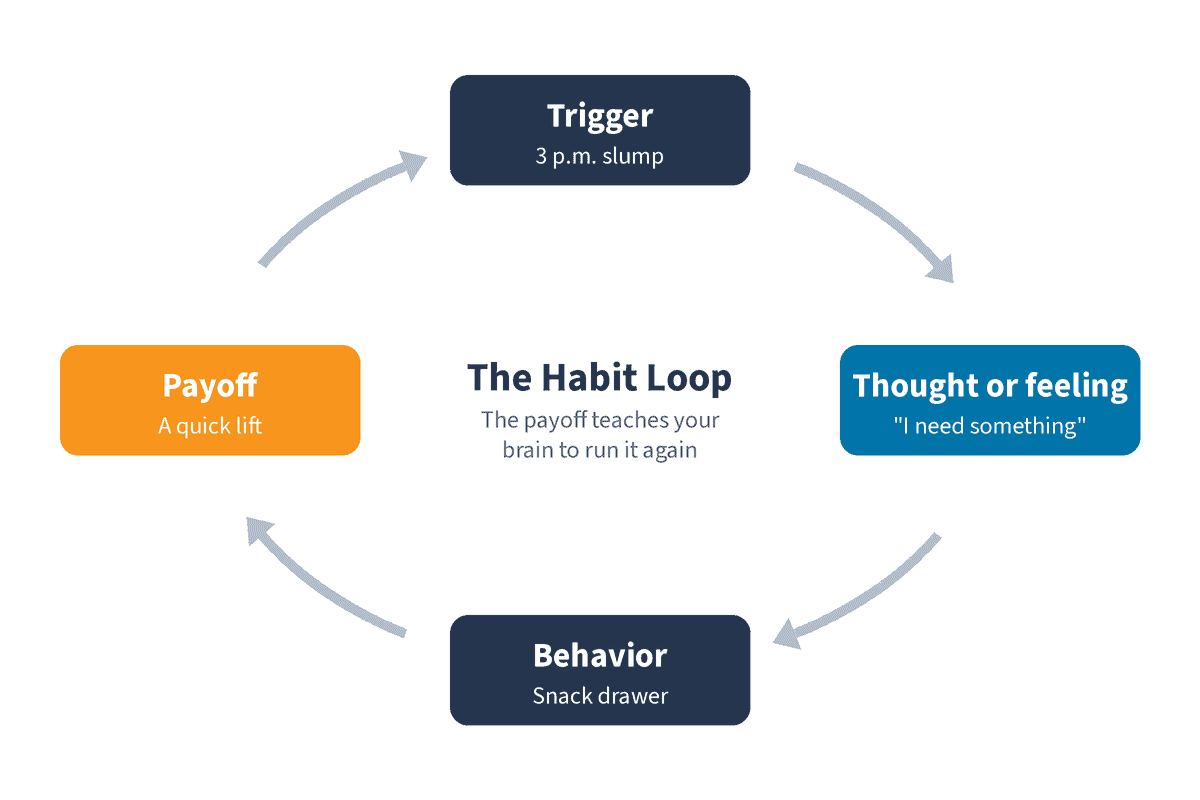
Your brain isn’t trying to trip you up. It found something that worked once, and it kept doing it.
The hidden payoff of a habit you hate
Here’s the part most people miss. Even a habit you hate gives you something. Usually it’s one of five things: comfort, control, relief, belonging or distraction.
Snapping at people can give you a sense of control. Putting things off gives you relief, at least for today. When the payoff wins over what you really want, it can feel like you’re working against yourself. My post on how to stop self-sabotage looks at that side of it.
The answer isn’t to shame the payoff. It’s to find a better way to get it.
[VIDEO: BREAKING THE PATTERN. Embed the YouTube video here, in Text view.]
How to Overcome Stubbornness (and What It’s Protecting)
To overcome stubbornness, ask what it’s protecting. Digging in often guards something that matters to you, like being right, staying in control or not looking foolish. Once you see what it’s guarding, you can protect that in a better way and open up to new ideas without feeling like you’ve lost.
Have you been called hard headed, set in your ways or as stubborn as a mule? It stings. But stubbornness isn’t a flaw in your character. It’s a pattern, and like any pattern, it has a payoff.
For many people, that payoff is safety. If you only do things your way, you can’t get them wrong. You never have to look foolish trying something new.
So how do you stop being stubborn? The next time you feel yourself dig in, pause and ask, “What am I afraid of losing here?” Then ask, “Is there a way to keep that and still listen?” Often there is.
Stubbornness can also be part of a bigger pull to keep things the same. I cover that in my post on overcoming the immunity to change. And yes, you can teach an old dog new tricks. Even a stubborn one.
How Do You Break Through a Mental Block?
You break through a mental block by spotting the “I can’t” behind it and testing it with one small step. Most blocks aren’t walls. They’re old beliefs that once kept you safe from failure or criticism. Small actions give your brain new proof, and the block starts to lose its grip.
Many blocks start with two words: “I can’t.” Maybe you tried something once and it went badly. Maybe someone told you that you couldn’t do it, and you believed them. Over time, “I can’t” starts to feel like a fact. My post on limiting beliefs digs into where these come from.
There’s another kind of block, too: the gap between where you are and where you want to be. Stare at that gap every day and it starts to look like the Grand Canyon. You freeze. So keep the big goal in mind, but put your attention on the next small step you can take today.
Some people choose to break through mental blocks with hypnosis, because it lets you rehearse the “I can” response until it feels natural.
How Does the Way You See Yourself Shape What You Do?
Your actions tend to follow your self-image. If you see yourself as “someone who always quits,” you’ll find reasons to quit. If you start to see yourself as someone who follows through, your choices slowly shift to match. That’s why changing a habit often starts with how you talk about yourself.
Listen to what you say about yourself. “I’m hopeless with money.” “I’ve always been lazy.” Lines like these become instructions your mind follows. My post on the power of words shows how much they shape your results.
So pick a new line, starting with “I’m the kind of person who…” For example: “I’m the kind of person who takes a walk when I’m stressed.” Say it before it’s fully true. You’re not fooling yourself. You’re giving your brain a picture of your ideal self to aim at.
And it’s never too late. Whether you’re 35 or 75, you can rewrite your story. Change has no expiration date. If you’d like a guided way to rehearse the person you’re becoming, try my free self-hypnosis audio.

When Your Thoughts and Words Run the Show
Thoughts lead to feelings, feelings lead to actions, and actions repeated become habits. So some of the toughest patterns live in what you think, say and decide. The fix is the same as with any habit: notice the moment, pause, and choose a better response.
Catch the thought
When a negative thought shows up, notice it and ask, “Is this helping me?” If not, swap it for one that’s more useful. Looking for the funny side helps, too. Getting cut off in traffic is annoying, but picturing the other driver as a cartoon character takes the sting out. My post on negative thought patterns has more ways to work with them.
Think before you speak
If you often say things you wish you could take back, build yourself a “mental pause button.” Take one breath before you answer. For texts and emails, wait 24 hours when you’re upset. You’ll often choose kinder words the next day.
When big decisions feel agonizing
If you go back and forth for weeks on a big decision, an old label may be at work, like “I always choose wrong.” Weigh the pros and cons, make the call, and remind yourself that a choice that doesn’t work out is a lesson, not a verdict on you.
Where Do These Patterns Show Up?
Patterns show up wherever there’s a trigger and a payoff. In my practice, I see them most with smoking and vaping, weight, sugar and stress. Each one runs on the same loop you’ve just read about, so each one can change in the same way.
Smoking and vaping
A cigarette or vape after coffee, in the car or on a break is a loop with a strong payoff: a pause and a sense of relief. Hypnosis helps you build a new response at those exact moments. Learn more about hypnosis to stop smoking and vaping.
Weight
Eating when you’re bored, tired or stressed often has more to do with the loop than with hunger. See how I help with hypnosis for weight loss.
Sugar
Sugar cravings often show up at the same times each day, like after dinner or in the afternoon slump. Read about hypnosis for sugar cravings.
Stress and anxiety
Stress loops, like worrying at night or reaching for your phone to escape, can change too. Hypnosis helps you practice a calmer response. Learn about hypnosis for stress and anxiety.
What If the Pattern Is Guilt About the Past?
Sometimes the loop is a replay of something you said or did years ago. It works like any other habit, with its own trigger and payoff. But guilt and shame deserve their own space, so I’ve written a full page on how to deal with guilt and shame.
When Should You Get More Help?
If a habit involves alcohol or drug dependence, an eating disorder, or anything risky to your health, please see a doctor or licensed professional first. If low mood or anxiety has lasted for weeks, start with your doctor or a licensed mental health professional. Hypnosis can sit alongside that care, but it isn’t a replacement for it.
How Does Hypnosis Help You Break a Pattern?
Hypnosis is a natural, focused state of attention, like being lost in a good book. You stay aware and in control. In that focused state, it’s easier to practice a new response until it starts to feel automatic. Hypnosis helps you work with the part of your mind that runs habits automatically, so change stops feeling like a fight.
I’m a certified hypnotist, and I work with busy adults who are tired of running the same old loop. We work on how you respond now, using the same four steps from the top of this page:
- Clarify the target. We get clear on what you want to stop or start, when it shows up and how you want to feel instead.
- Find the pattern. We map your loop and name its hidden payoff.
- Install the upgrade. In hypnosis, you rehearse your new response at the trigger point: the 3 p.m. slump, the drive home, a tense conversation. I give you suggestions that link the old trigger to the new response, so the new choice comes to mind more easily when the moment arrives. We also use “I’m the kind of person who…” language.
- Reinforce in real life. You leave with a short daily practice of 2 to 5 minutes and a plan for the days it doesn’t go well. No shame attached.
What Happens in a Session?
Your first session is a 90-minute Clarity Session, in person at my Mashpee office or online. We start by talking about the pattern and what you want instead. Then I guide you into a relaxed, focused state. You hear everything and stay in control the whole time.
The Clarity Session’s job is to understand what keeps your loop going and to work out what, if anything, you need next. If more sessions make sense, they’re 60 minutes each. It’s your goal, at your pace.
Frequently Asked Questions About Breaking a Pattern
Why doesn’t willpower work?
Willpower works with the thinking part of your mind, but habits run on autopilot. When you’re tired or stressed, autopilot usually wins. That’s not weakness. It’s how habits work. Change tends to last when you practice a new response until it becomes your new autopilot.
How long does it take to break a habit?
It depends on the habit and on you. In my experience, starting a new habit is often quicker than changing an old one, which can take weeks or months. Daily practice and a plan for slips matter more than any number on a calendar.
Is being stubborn a bad thing?
Not always. Being determined can help you finish hard things. Stubbornness becomes a problem when it shuts out good ideas or strains your relationships. It helps to ask what your stubbornness is protecting, then find a better way to protect it.
Will I be in control during hypnosis?
Yes. Hypnosis is a focused state, not sleep. You hear everything, you stay aware, and you can’t be made to do anything you don’t want to do. You’re an active part of the work the whole time.
How many sessions does it take?
It depends on you and the pattern, so I can’t give a number up front. We start with a 90-minute Clarity Session to understand what keeps the loop going. Then we decide together what, if anything, comes next. Follow-up sessions are 60 minutes each.
Where to Go From Here
If this sounds like you, you don’t have to do this alone. When you’re ready to try something different, pick the step that fits where you are today.
Start with a free self-hypnosis lesson.
My free 16-minute audio, The Float-In Method, teaches you a simple way to calm your body and mind, then rehearse the outcome you want. It’s a mental rehearsal, not only relaxation. You might rehearse walking past the snack drawer at 3 p.m. and feeling fine about it. Listen seated, never while driving. Get the free audio
Go deeper with the Mind Shift Method.
This is the full program the free lesson comes from. It uses short videos, simple guides, and hypnosis audio to help you change a pattern that keeps repeating, at your own pace. Learn about the Mind Shift Method
Talk with me.
If you’d like one-on-one help, book a free 20-minute phone consultation. It’s a first conversation about whether a Clarity Session is the right first step for you: one focused session to understand what keeps your loop going. Let’s make a plan that fits your real life. No pressure, just a conversation. Book your free consultation
About the Author
Erika Slater, CH, has been a certified hypnotist since 2004. She works with busy adults in person at her office in Mashpee on Cape Cod, and online.
CATEGORIES
FEATURED POSTS
Interested in making a significant change in your life and interested in learning more about what I do and how I do it? Discover more about my hypnosis services.
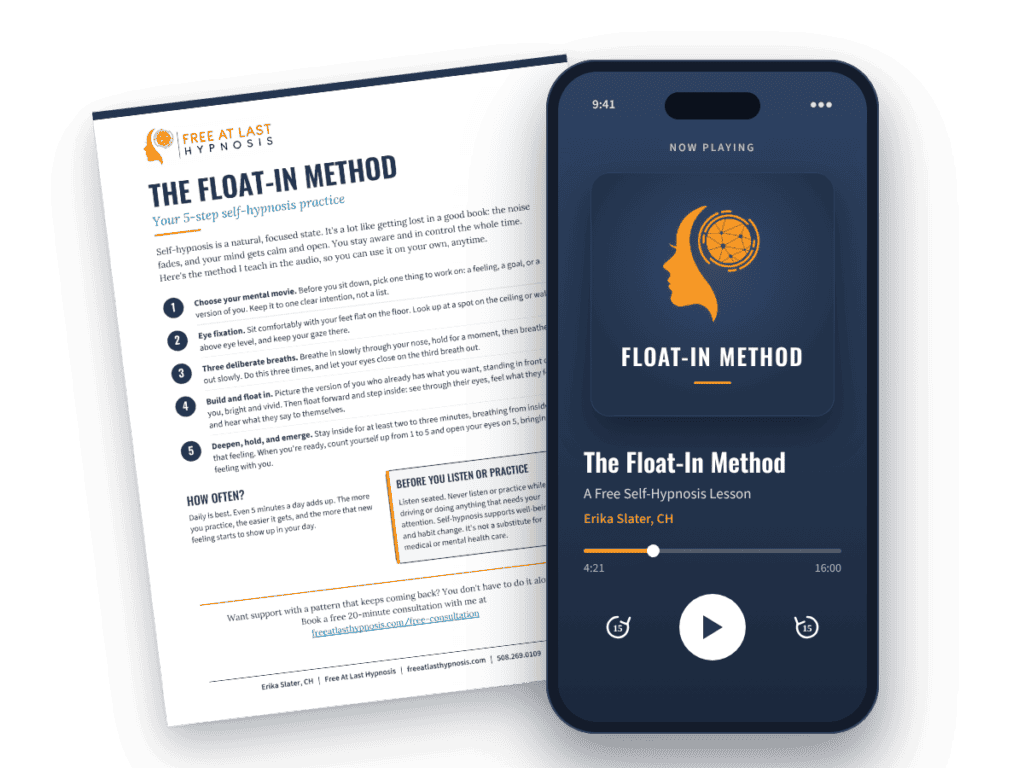
Learn Self-Hypnosis in 16 Minutes, Free
In this free audio lesson, I'll teach you the float-in method. It's a simple way to work with your mind instead of fighting it. You'll do it once with me guiding you. Then you can use it on your own, anytime. A one-page guide comes with it.
