
The Fear of Growing Old Alone, and
How to Make the Next Chapter a Good One
by Erika Slater
Maybe you retired last spring and the days are longer than you expected. Maybe the last kid moved out, or a partner is gone, and the house is quieter than it’s ever been. Your knees have opinions now. The circle of people you see each week has gotten smaller, and nobody warned you that would happen.
You’re capable. You’ve handled harder things than this. But some days you feel stuck, and some nights a quiet worry shows up: what if I end up growing old alone?
If that’s you, this page is for you. It won’t tell you to think positive and book a cruise, or join a gym class (although muscle loss anybody?). It’ll show you what actually helps: a few real connections, a chapter with a purpose, and a way to change the patterns that keep you home when you’d rather be out. I’m Erika Slater, a certified hypnotist in Mashpee on Cape Cod, and I’ve sat across from a lot of people at this exact turning point.
In this article:
- How do you stop fearing growing old alone?
- How do you make the most of the next chapter?
- Why does change feel harder later in life, and why is it still possible?
- It’s about attitude, not age
- Feeling stuck or trapped in this stage of life?
- How do you live in the moment?
- Reinventing yourself after 50
- When loss and regret are part of the picture
- When should you get more help?
- How does hypnosis help with aging well and life transitions?
- What happens in a session?
- Frequently asked questions
- Where to go from here
[Jump links to the H2 headings, added by hand in Text view as on the other hub pages.]
How do you stop fearing growing old alone?
You stop fearing growing old alone by building a life that holds up with or without a partner in it: two or three people you can call, one standing weekly thing, and a day that has a shape. The fear shrinks when you can name who’d pick up the phone. Here’s how to get there.
Alone isn’t the same as lonely
Being alone is a fact. Lonely is a feeling. They don’t always show up together. I know people who live by themselves and are rarely lonely, and people in long marriages who are lonely every evening. So the question isn’t “Am I alone?” It’s “Do I have people, and do I matter to them?”
Here’s a simple test. Think about a bad day: the car won’t start, or you got news you didn’t want. Who would you call for help or a sympathetic ear? If one or two names come to mind right away, you’re in better shape than you think. If you had to stop and search, that’s not a verdict on you. It’s a to-do list for a gap to fill.
The fear of growing old alone is really the fear of having no one to call. And that’s a problem with a fix.
Scared of growing old alone? Start with two people, not twenty
You don’t need a crowd. Most people with hundreds of online friends would admit there are only two or three they’d call at 2 a.m. So aim for two or three:
- Pick one standing thing each week. A class, a walking group, a volunteer shift, a Tuesday coffee. Regular beats random. Friendship grows from showing up in the same place at the same time with a warm nature.
- Choose activity over small talk. Deep friendships often start with people who share an interest: gardening, cards, a book club, pickleball. Side by side is easier than face to face.
- Be the one who asks. “Want to get coffee after?” It’s five words. It’s awkward for about four seconds. Most people are relieved someone asked.
- Use what’s local. Most Cape Cod towns have a council on aging with classes, trips and lunches. It’s a room full of people who also want company.
Don’t rush into a relationship just to avoid being alone. That trades one worry for a bigger one. Build the friendships first. If a partner comes along later, wonderful. If not, you still have a life you like.
How do you make the most of the next chapter?
You make the most of the next chapter by deciding what it’s for. Pick one thing to learn, one way to move your body, and one place to show up each week. Add a reason to get up in the morning that isn’t a job. Small, steady choices do more than one big plan.
Decide what this chapter is for. Not forever. Just for now. “This year is for getting strong again.” “This year is for the book I keep saying I’ll write.” One sentence. Put it on the fridge or in the bathroom.
Keep your body moving. Walk 15 to 20 minutes a day and build from there. Add stretching, yoga, jogging, or tai chi for balance. I’m not suggesting you try out for right field with the Red Sox or train for the Cape Cod Marathon. You’re keeping the engine running so it can take you places. And eat like you plan to be here a while. If I have to define moderation, we’re kidding each other.
Spend time with people who are busy with the next thing, not waiting it out. You become like the people you spend time with. Choose the busy ones.
Give some of it away. Teach, volunteer, watch the grandkids. Being needed is a strong reason to get up.
How to grow old alone, and do it well
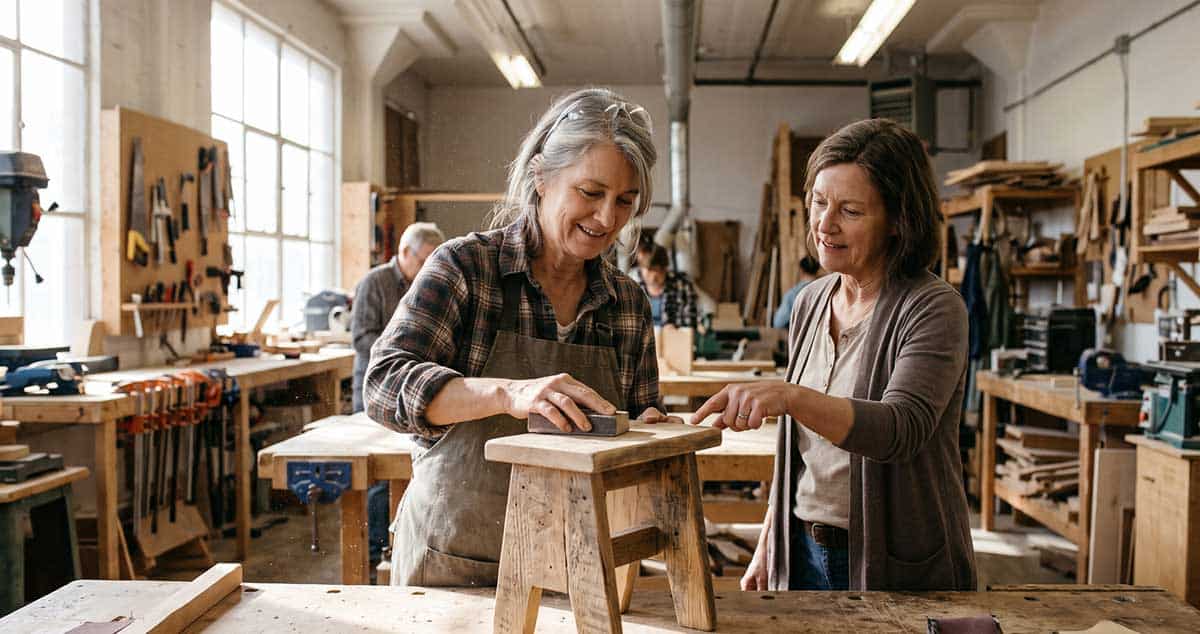
Some readers aren’t looking for a partner and don’t plan to. Good. Living on your own at this stage can be a rich life, and the people who do it best plan for it on purpose. They keep two or three close friends. They know their neighbors. They have a routine with a shape: a morning walk, tea at four. And someone would notice if they didn’t show up. Alone by choice is a fine way to live. Alone by accident is the thing to avoid.
Why does change feel harder later in life, and why is it still possible?
Change feels harder later in life because your habits have had decades to settle in, and because staying put feels safe. But a habit is a learned pattern, and your mind can learn new patterns at any age. Once you can see the pattern, you can change it.
Here’s a pattern I see all the time. The trigger: a Thursday evening, or an invitation to something new. The thought or feeling: “Too much bother.” “I’d be the oldest one there.” “Maybe next time.” The behavior: you stay home. The payoff: staying home feels safe right now. Nothing goes wrong. Nobody sees you fumble.
That payoff is the sneaky part. The pattern isn’t stupid. It’s protecting you from something. The trouble is, it’s also protecting you from your own life, and every night in reinforces the habit.
Your body did change, and some things are harder. But “too late for me” is a thought, not a fact. My clients in their 60s and 70s change patterns the same way my clients in their 30s do, because the part of the mind that runs habits works the same at every age. It just has more practice at the old habit. So we give it some practice at the new one.
[VIDEO: IS IT TOO LATE TO CHANGE?] (embed the YouTube video here in Text view; the video plan is at the end of this document)
It’s about attitude, not age
How you see yourself shapes how you age. If you decide you’re “past it,” you’ll start acting past it, and your body and your calendar will follow. If you see yourself as someone with things to do, you’ll do them. Age is a number. Attitude is a choice you make every morning.
Past it. Over the hill. Past what, exactly? The clients who seem youngest to me aren’t the ones with the best skin. They’re the ones who are curious, who have plans, who laugh easily and complain rarely. I’ve met people in their 70s who feel younger than clients half their age. The difference is how they see themselves.
I plan to live well into my nineties. I may need to upgrade my chair by then, but I don’t plan to spend those years waiting, and the attitude I carry today is what I’m counting on to get me there.
Feeling stuck or trapped in this stage of life?
Feeling trapped at this stage of life is common, and it’s almost always a feeling rather than a fact. Unless there’s a locked door, you have more choices than it seems. The way out starts with one small choice you make today, not a plan to fix everything at once.
Trapped can look like a house that’s too big and too quiet, a caregiving role that never ends, or a retirement that was supposed to feel free and mostly feels empty.
Ask yourself: am I actually trapped, or do I feel trapped? That’s not a trick question. Some situations really do limit you. But what keeps most people stuck is what they tell themselves: “There’s nothing I can do.” “This is just how it is now.” Say that often enough and the mind believes it, and a mind that believes it stops looking for the door.
So look for the door. Not the big one. The small one. Call the friend. Sign up for the class. Say yes to the thing you’d usually say no to. One act of choice reminds you you’re still the one driving.
If the stuck feeling has a loop to it, like a worry you can’t put down or a habit you reach for when the evening gets quiet, that’s the kind of pattern I work with. You’ll find more on my special hypnosis services page. And if you’d like something to try tonight, I’ve made a free way to practice feeling calm on your own. It’s a short audio lesson. Listen seated, never while driving.
How do you live in the moment?
You live in the moment by living on purpose instead of by default: deciding what matters today, giving it your full attention, and noticing the good parts while they’re happening. It’s a skill, not a personality type, and it takes about two minutes a day to practice.
A lot of people at this stage are still waiting for something. Waiting for the weekend, even though every day is the weekend now. Waiting for the kids to call. Waiting for someone, or the universe, to show up and change things.
Living in the moment means you stop waiting and start choosing. Each morning, ask: what matters today? Pick one thing and give it your whole attention. Then notice it while it’s happening: the coffee, the walk, the conversation. Noticing is the difference between living a day and getting through one.
One idea that helps many of my clients is to measure today against where you started, not against where you wish you were. It’s called The Gap and the Gain, and I talk about it in my free short videos on happiness. They’re a few minutes each, and anyone can watch.
Reinventing yourself after 50
Some people reach this stage and want a whole new act: a new skill, a small business, a move, volunteering, a version of themselves they didn’t have time for before. That’s not a midlife crisis. It’s an invitation. If that’s you, I’ve written about how to reinvent yourself for the next phase of life, with hypnosis as one of the tools.
When loss and regret are part of the picture
Sometimes the hard part of this life chapter isn’t the future. It’s a loss that never got a clean ending, or a choice you keep replaying at 3 a.m. That deserves its own article, so I’ve written one on living with a loss that has no closure, and how to stop replaying regret. Read it when you’re ready.
When should you get more help?
If loneliness or low mood has lasted for weeks, or you’ve lost interest in things you used to enjoy, the right first step is your doctor or a licensed mental health professional. Memory changes and health worries belong with a doctor too. Hypnosis can sit alongside that care, but it isn’t a replacement for it. Asking for that kind of help is good judgment, not weakness.
How does hypnosis help with aging well and life transitions?
Hypnosis helps with aging well by changing the patterns underneath: the “too late for me” thought, the habit of staying home. It doesn’t slow the clock. It changes how you meet the years, and it works alongside the walks and the friendships, not instead of them.
First, what hypnosis is. It’s a natural, focused state of attention, like being lost in a good book. You stay aware and in control the whole time. Hypnosis helps you work with the part of your mind that runs habits automatically, so change stops feeling like a fight.
Some people search for anti aging hypnosis, so let me be clear about what that can and can’t mean. Hypnosis won’t slow the body’s aging or smooth a single wrinkle. What it can change is your attitude about your age, the habits that keep you active, and the picture you carry of yourself. Those decide how you live your years. Hypnotherapy for life transitions, as I offer it, uses the same four steps I use with every client.
Clarify the target
What do you want this chapter to look like and feel like? “Feel younger” is too big to aim at. “Say yes to one invitation a week, and enjoy it” is something we can work with. We get specific.
Find the pattern
Every stuck place has a trigger, a thought or feeling, a behavior and a payoff. The trigger is the invitation. The thought is “too much bother.” The behavior is staying home. The payoff is that staying home feels safe right now. Once we can see the whole loop, we know where to work.
Install the upgrade
In hypnosis, we practice a new response at the trigger point. The invitation comes, and instead of “too much bother,” there’s a breath and “let’s see.” We use identity language: “I’m the kind of person who shows up.” And we rehearse it in real situations: the class on Tuesday, the first time you walk into a room full of strangers.
Reinforce in real life
Change holds when it’s practiced. You leave with a small daily practice, two to five minutes, and a plan for the days it doesn’t go well. Slipping isn’t failing. It’s a day you course-correct, with no shame attached.
You can read more about how I work with life transitions and other patterns on my special hypnosis services page.
What happens in a session?
We start with a conversation, not a swinging watch. You tell me what’s going on and what you’d like this life chapter to look like. If it’s a fit, the first step is usually a Clarity Session: one focused session to understand what’s keeping you stuck and to make a plan you can actually follow.
Sessions are in person at my office in Mashpee on Cape Cod, or online. You’re awake, aware and in control throughout. You set the pace. I bring the tools. And we’re clear from the start about what belongs with your doctor instead.
Frequently asked questions
Am I too old for hypnosis?
No. Hypnosis is a focused state of attention, and the part of your mind that runs habits works the same at every age. Many of my clients are in their 60s and 70s. If you can get lost in a good book or a ball game, you can use hypnosis.
Can hypnosis help with the fear of growing old alone?
It can help with the patterns around the fear: the worry loop at night, the habit of saying no, the story that it’s too late to make friends. It doesn’t replace real connection. It helps you become the person who goes out and builds them.
Is anti aging hypnosis real?
Hypnosis doesn’t slow physical aging, and anyone who says it does is usually selling an expensive cream. What it can change is your attitude about your age and how you see yourself. Those shape how you live your years, and that’s what most people mean when they search for it.
Do I have to come to Mashpee, or can we work online?
Both work. My office is in Mashpee on Cape Cod, and I also see clients online via Zoom. Online sessions use the same approach and take the same time. Pick whichever fits your life.
What if I don’t know what I want the next chapter to look like?
That’s a normal place to start, and it’s often the first thing we work on. A Clarity Session is built for it: one focused conversation to figure out what you want more of, what’s in the way, and a first step you can take this week.
Where to go from here
If this sounds like you, you don’t have to do this alone. Pick the next step that fits where you are today.
Start with a free self-hypnosis lesson.
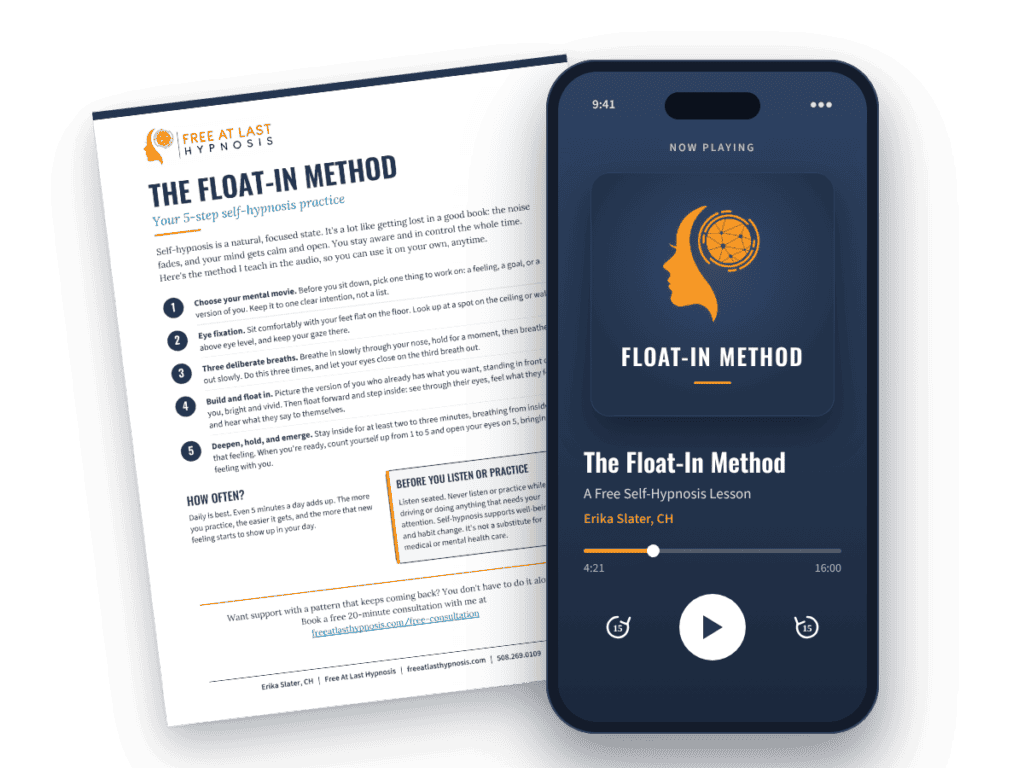
My free 16-minute audio, The Float-In Method, gives you a few calm minutes to settle your body and mind, then a quiet rehearsal of the next chapter you want. Use it before a class, a phone call, or any morning you’d rather stay in. Find a comfortable chair first. Listen seated, never while driving. Get the free audio
Talk with me.
If you’d rather talk it through, book a free 20-minute consultation. We’ll talk about what’s going on and whether a Clarity Session is the right first step: one focused session to understand what’s keeping you stuck and make a plan. Let’s make a plan that fits your real life. Book your consultation
Erika Slater, CH, has been a certified hypnotist since 2004 and works with clients in person in Mashpee on Cape Cod and online. She helps adults change the patterns that keep them stuck, so the next chapter stops feeling like a fight.
CATEGORIES
FEATURED POSTS
Interested in making a significant change in your life and interested in learning more about what I do and how I do it? Discover my hypnotherapy services here or contact me here.
Learn Self-Hypnosis in 16 Minutes, Free
In this free audio lesson, I'll teach you the float-in method. It's a simple way to work with your mind instead of fighting it. You'll do it once with me guiding you. Then you can use it on your own, anytime. A one-page guide comes with it.
