
How to Deal With Guilt and Shame, and Stop Living in the Past
by Erika Slater
It plays again while you’re driving. Or washing dishes. Or lying awake at 2 a.m. The sharp thing you said. The call you didn’t make. The years you can’t get back.
You’re still getting through your days. But the guilt and shame run quietly underneath, and they wear you down.
If that’s you, you’re not broken. Your brain learned a pattern, and patterns can change. This page starts with what helps: clear steps for how to deal with guilt and shame, how to live with guilt you can’t undo, and how to stop living in the past. Then I’ll show you where hypnosis fits.

How Do You Deal With Guilt and Shame?
To deal with guilt and shame, first name which one you’re feeling. Then ask what it’s pointing to. Make a repair if you can and you choose to. Keep the lesson in one sentence. And learn to catch the replay when it starts, so it stops running your day. Here’s how each step works.
1. Name it: is this guilt or shame?
Guilt is about something you did, or didn’t do. Shame is about who you think you are. “I did a bad thing” is guilt. “I’m a bad person” is shame. Many people find a feeling is easier to work with once it has a name.
2. Ask what the guilt is pointing to
Guilt isn’t always the enemy. Often it’s a signal that you care about something, like being kind, being honest or showing up. Ask yourself, “What is this guilt asking me to do?” If there’s a clear answer, that’s healthy guilt doing its job. If the answer is “nothing, it’s too late,” the next section is for you.
3. Make a repair, if you can and if you choose to
If someone was hurt and you can still reach them, a repair may be possible. It could be an apology. It could be paying something back, or showing up in a new way from now on. Whether you do it, and how, is up to you. It’s an option, not a duty.
4. Keep the lesson in one sentence
Ask, “What would I do next time?” Write the answer in one plain sentence. For example: “When I’m angry, I’ll wait a day before I answer.” Once you have the lesson, the replay has nothing new to teach you.
5. Catch the replay and give it a new ending
The replay likes to start by itself. When you notice it, tell yourself, “There’s the replay.” Take one slow breath. Feel your feet on the floor. Say your one-sentence lesson, then turn to the next small thing in front of you. You’re not fighting the memory. You’re practicing a new response to it.
6. Notice what you do so you don’t have to feel it
Guilt and shame often hide under other habits. Stress eating. An extra glass of wine. Staying so busy there’s never a quiet moment. These are common ways of coping with guilt and shame, and there’s nothing wrong with you if one of them is yours. It’s your mind looking for relief. It helps to see the link, because then you know what you’re really working on.
Key takeaway: That’s how to get over guilt and shame. You don’t forget. You learn, you repair where you can, and you practice a new response.
How Do You Live With Guilt You Can’t Undo?
Sometimes there’s no repair to make. The person has died. The marriage is over. The time is spent. You live with guilt you can’t undo by keeping the lesson and putting down the punishment. The past stays the same. How you carry it can change.
Many people hold on to guilt like a debt. It can feel as if hurting over it is the least you owe. But replaying it for years doesn’t help the person you hurt, and it doesn’t change what happened.
Here are some options. Take what fits and leave the rest.
- Say what you wish you’d said. Write a letter you never send, or say it out loud in a quiet place.
- Do some good in their name. Some people call this a living amends. You show up for the people in your life now the way you wish you had then.
- Think about forgiving yourself. For some people that feels right. For others it doesn’t, or not yet. Either is okay.

You may always wish it had gone another way. That’s regret, and regret can sit beside a good life.
Guilt or Shame: What’s the Difference?
Guilt is about what you did. Shame is about who you believe you are. Healthy guilt points to a repair or a lesson, and then it eases. Stuck guilt keeps replaying after there’s nothing left to do. Shame says the problem is you, and it makes people want to hide.
- Healthy guilt: “I snapped at my sister. I’ll call her and say sorry.” It has a job. When the job is done, it fades.
- Stuck guilt: “I snapped at my mother years ago, and she’s gone now.” There’s no call to make, so your mind plays it over and over.
- Shame: “I’m a terrible daughter.” It’s no longer about what happened. It’s about you.
Shame can also grow from things you never chose, like money trouble, a hard childhood or not finishing school. Wherever it started, shame is a learned response. What’s learned can be updated.
Why Does Guilt Keep Replaying?
Guilt keeps replaying because the replay has become a habit, and habits run on a loop. Something sets it off. A thought and a feeling follow. You go over it again. Then you get a small payoff: going over it feels like doing something about it.
Here’s the loop for guilt:
- Trigger: a date on the calendar, a song, a photo, seeing the person.
- Thought or feeling: “I should’ve been there.” A drop in your stomach.
- Behavior: you replay it, or you reach for food, a drink or your phone.
- Payoff: a moment of relief, or the sense that you’re paying what you owe.
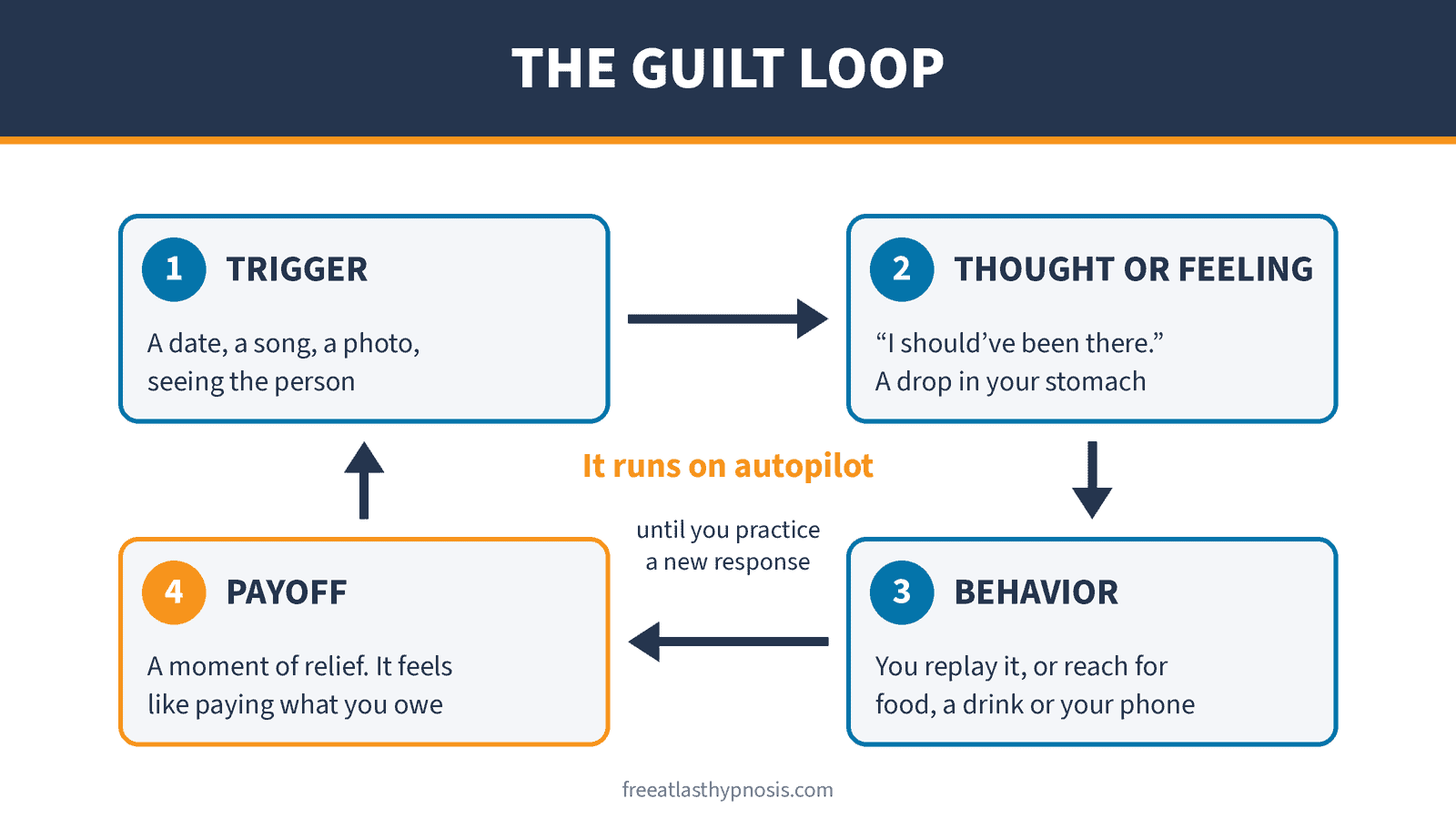
That payoff is why the loop is so sticky. Part of you may believe that if you stop replaying it, you’re letting yourself off the hook. So your mind keeps it going on autopilot. That’s not a flaw in you. It’s a pattern your brain practiced until it ran by itself. And a practiced pattern can be changed with practice.
[VIDEO: GUILT LOOP]
How Do You Stop Living in the Past?
You stop living in the past when you use it as a place to learn from, not a place to live. You can’t go back and change one minute of it. Every choice you’ll ever make happens today. So the work is to keep bringing your attention back to now.
Many of us spend hours a day going back to fix a moment that can’t be fixed. If anyone ever builds a working time machine, I’d like to hear about it. Until then, today is the only day we can do anything with.
Try these:
- Ask, “What can I do today?” One small thing counts.
- Use your senses. Name three things you can see and two you can hear. It pulls your mind back into the room.
- Practice. Coming back to the present is a skill, and it gets easier. My audio lesson, The Float-In Method, is a free way to practice feeling calm on your own.
When the Guilt Is About Someone You’ve Lost
Some of the heaviest guilt comes with loss. Things left unsaid to someone who has died. A family tie that broke and never mended. If that’s where you are, my page on ambiguous loss goes deeper into regret and loss without closure.
When Should You Get More Help?
If guilt or shame has felt heavy for weeks, or it’s getting in the way of your sleep, your work or taking care of yourself, please talk with your doctor or a licensed mental health professional first. That’s the right first step. Shame that’s tied to abuse or trauma also belongs with licensed care. Hypnosis can sit alongside that care, but it isn’t a replacement for it. And if you’re having thoughts of not wanting to live, call or text 988, the Suicide and Crisis Lifeline.
Hypnosis for Guilt and Shame: How It Helps
Hypnosis is a natural, focused state of attention, like being lost in a good book. You stay aware and in control. It doesn’t erase a memory or change the past. It helps you change the loop around the memory, so you can respond in a new way when it comes up.
Hypnosis helps you work with the part of your mind that runs habits automatically, so change stops feeling like a fight.
I’m a certified hypnotist, and I work with busy adults who are tired of the replay. I don’t do regression. We don’t go back into old memories or hunt for a hidden cause. We work on how you respond now, in four steps.
- Clarify the target. What keeps replaying? When does it show up? How would you like to feel when it does? Most people don’t say “nothing.” They say “calm,” or “sad but steady.”
- Find the pattern. We map your loop: trigger, thought or feeling, behavior, payoff. With guilt, the payoff is often the sense of paying a debt.
- Install the upgrade. In hypnosis, you practice a new response at the trigger point. We use identity language, such as “I’m the kind of person who learns from my past and lives my life today.” Then you rehearse real moments ahead: the anniversary, the family dinner, seeing the person involved.
- Reinforce in real life. You leave with a small daily practice of 2 to 5 minutes. We also plan for the days it doesn’t go well. You notice, you reset, and you carry on. No shame attached.
What Happens in a Session?
Your first session is 90 minutes, in person at my Mashpee office or online. We start by talking about what’s going on and what you want instead. Then I guide you into a relaxed, focused state. You hear everything, you stay in control, and you don’t have to relive anything.
We begin with a Clarity Session. Its job is to understand what keeps your loop going and to work out what, if anything, you need after it. If more sessions make sense, they’re 60 minutes each. It’s your goal, at your pace.
Frequently Asked Questions About Guilt and Shame
How do I stop feeling guilty about something I can’t change?
Start by asking what the guilt is trying to tell you, and keep that lesson in one sentence. Then practice catching the replay when it starts and turning back to today. You may still feel regret at times. The aim is for the guilt to stop running your days.
How do I get rid of a guilty conscience?
A guilty conscience usually means you care about doing right, so the aim isn’t to get rid of it. Listen to what it’s asking for. If a repair is possible and you choose to make it, do that. If it isn’t, keep the lesson and work on the replay.
Can hypnosis make me forget what happened?
No. Hypnosis doesn’t erase memories, and I wouldn’t want it to. The memory stays. What can change is how you respond when it comes up. The aim is to remember what happened without the same heavy pull, and to keep the lesson it gave you.
Will I have to relive or talk through what I did?
No. I don’t do regression, so we don’t go back into old memories. You can share as much or as little as you like. I need to know how the guilt or shame shows up in your life now, so we can work on how you respond today.
How many sessions will I need?
It depends on you, so I can’t give a number up front. We start with a 90-minute Clarity Session to understand what keeps the loop going. From there we decide together what, if anything, comes next. Follow-up sessions are 60 minutes each.
Where to Go From Here
If this sounds like you, you don’t have to do this alone. You’ve carried this long enough to know how heavy it is. When you’re ready to put it down, pick the step that fits where you are today.
Start with a free self-hypnosis lesson.
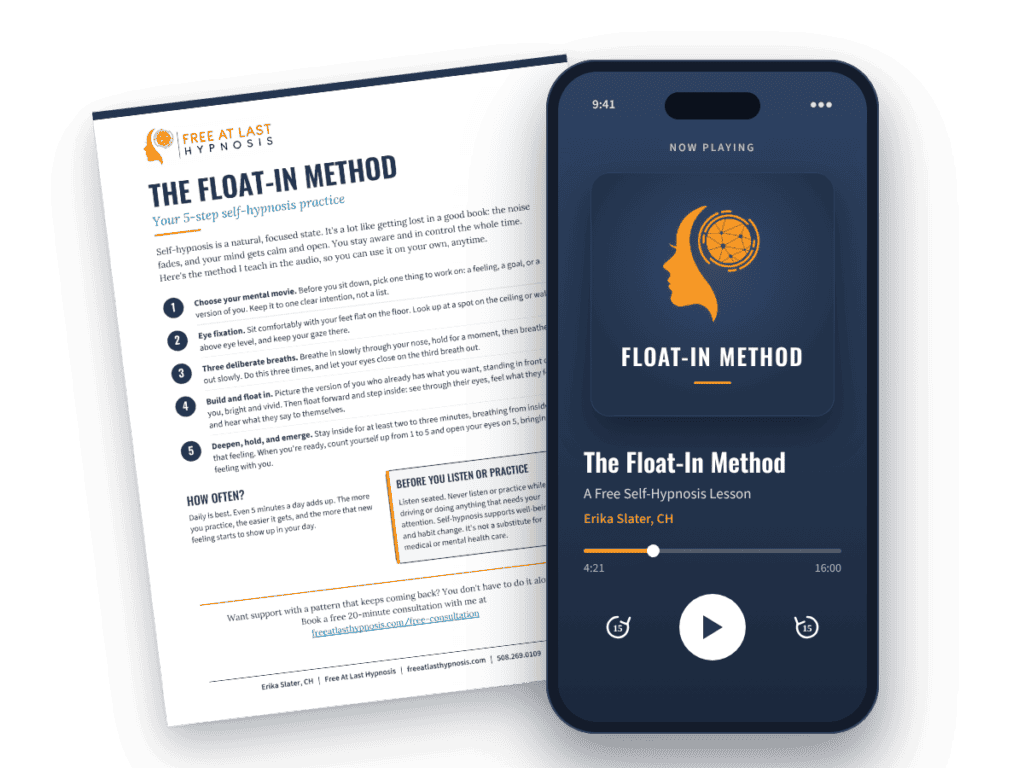
My free 16-minute audio, The Float-In Method, teaches you a simple way to calm your body and mind, then rehearse the outcome you want. It’s a mental rehearsal, not only relaxation. You might rehearse getting through a hard date on the calendar and feeling steady. Listen seated, never while driving. Get the free audio
Go deeper with the Mind Shift Method.
This is the full program the free lesson comes from. It uses short videos, simple guides, and hypnosis audio to help you change a pattern that keeps repeating, like the replay, at your own pace. Learn about the Mind Shift Method
Talk with me.
If you’d like one-on-one help, book a free 20-minute phone consultation. It’s a first conversation about whether a Clarity Session is the right first step for you: a focused session to understand what keeps your loop going. Let’s make a plan that fits your real life. No pressure, just a conversation. Book your free consultation
About the Author
Erika Slater, CH, has been a certified hypnotist since 2004. She works with busy adults in person at her office in Mashpee on Cape Cod, and online.
CATEGORIES
FEATURED POSTS
Interested in making a significant change in your life and interested in learning more about what I do and how I do it? Discover more about my hypnosis services.
Learn Self-Hypnosis in 16 Minutes, Free
In this free audio lesson, I'll teach you the float-in method. It's a simple way to work with your mind instead of fighting it. You'll do it once with me guiding you. Then you can use it on your own, anytime. A one-page guide comes with it.
